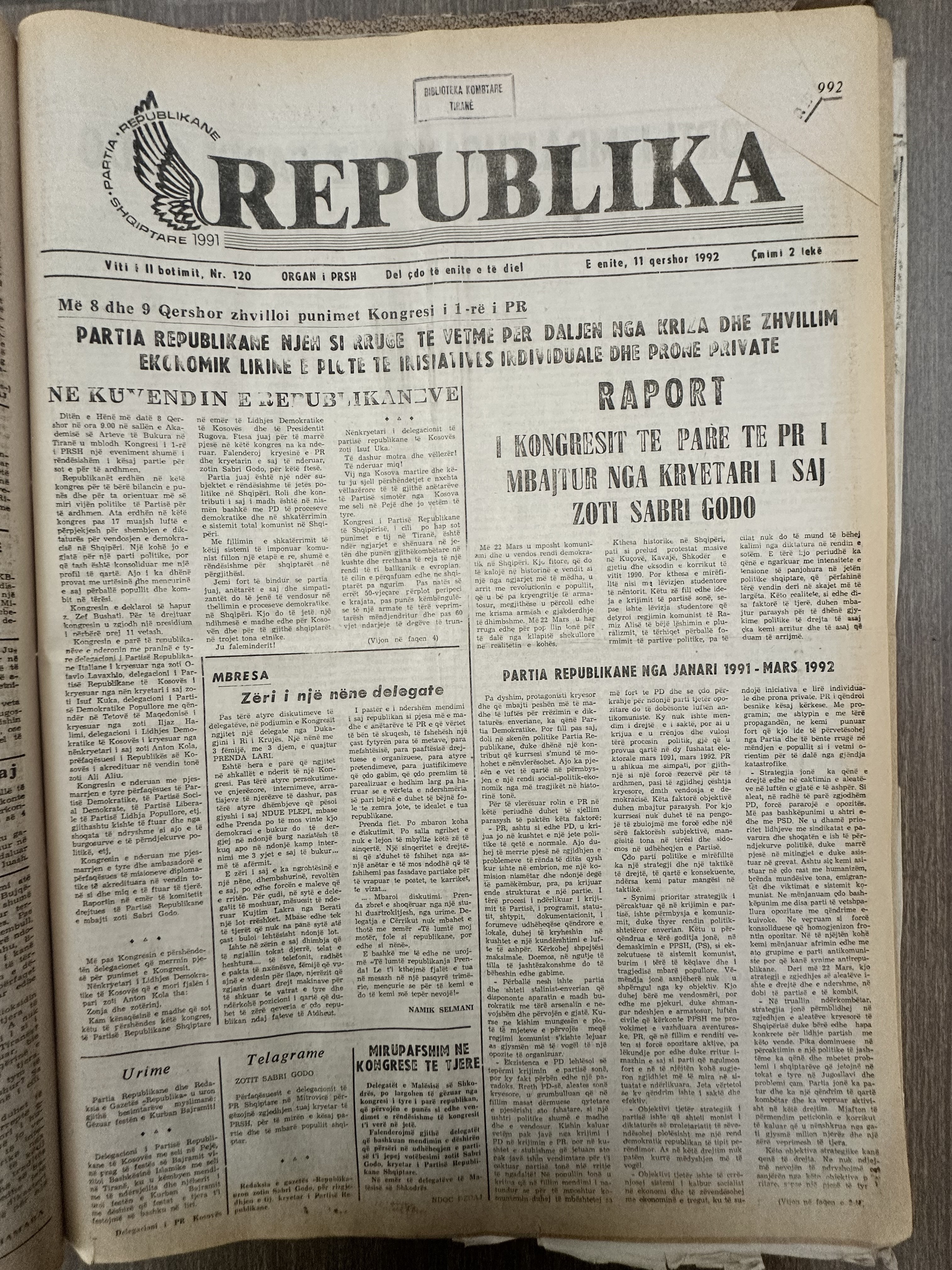
Report of the First Congress of PR delivered by its chairman, Mr. Sabri Godo
RAPORT I KONGRESIT TË PARË TË PR I MBAJTUR NGA KRYETARI I SAJ ZOTI SABRI GODO
Relazione del primo Congresso del PR tenuta dal suo presidente, sig. Sabri Godo
Original newspaper scan
REPORT
OF THE FIRST CONGRESS OF PR
DELIVERED BY ITS CHAIRMAN
MR. SABRI GODO
On 22 March communism was defeated and political reconstruction was established in Albania. This victory, which will go down in the country’s history as one of the greatest events, was achieved through the people’s revolution, as well as through armed uprising, although the weapons of painful bloodshed were also fully used. On 22 March a 50-year regime was overthrown and the path was opened to freedom and the reality of the time.
The historical turning point in Albania was preceded by the mass protests in Kavaja, Vlorë, Shkodër and elsewhere, and by the exodus of July 1990. But the genuine turning point began with the student movement of November. Here too the idea of creating our party took shape, because it was the student movement that forced Ramiz Alia’s communist regime to accept pluralism and to retreat in the face of the strengthening of political parties, without which the transition from dictatorship to the present order could not have been made. This entire period has been marked by intensities and tensions unknown in Albanian political life, affecting the whole country down to its most remote corners. These realities, as well as certain other factors, must be borne in mind in order to make fair political judgments about what we have achieved and what we want to achieve.
THE REPUBLICAN PARTY FROM JANUARY 1991 TO MARCH 1992
Without doubt, the main protagonist and the one bearing the greatest burden in the struggle to bring down the Enverist dictatorship was the Democratic Party. But alongside it, the Republican Party appeared on the political scene, making a contribution that certainly cannot be denied or underestimated. It had its own share in overturning one of the most tragic social-political-economic orders in the history of humankind.
To assess the role of PR in this period, we must take at least the following factors into account:
- PR, like PD, was not created under conditions of calm and normal political life. It had to take part in addressing the serious issues of the day from the moment it was still in embryo, with an initiatory committee and under severe time constraints, before the structures of a party had even been formed. The entire complex process of creating the Party, its program, statute, press, documentation, and the central and local leadership bodies, had to be carried out under conditions of fierce opposition and struggle. Maximum speed was required. Naturally, in such extraordinary circumstances, mistakes would also be made.
- Opposed to us was the Stalinist-Enverist party and state, which possessed a large bureaucratic apparatus with all the necessary tools to defend and strike. The conditions in which we were creating it also included a complete lack of means and experience with organized opposition.
- The existence of PD unquestionably made the creation of PR necessary, though this factor also constituted an obstacle. Around PD, our main ally, there gathered at first the urban masses and partly the rural ones, like a very large and determined political army. Only a few weeks had passed from the creation of PD to the creation of PR, but under the stormy conditions that emerged after the decisive wave, our party was to experience slow growth. From the outset, our population naturally entered with enthusiasm, and to earn applause and maturity we had to rely as strongly as possible on PD; the belief that support from any other opposition party would weaken the anti-communist struggle was not a correct one. True, but it was created and took root and permeated the entire political process, which hindered growth in the two electoral campaigns, March 1991 and March 1992. PR was viewed with sympathy, but always as a reserve force for the future, after the main issue had been resolved, namely the establishment of democracy. These objective factors must be taken into account. But this must in no way prevent us from strongly uncovering a series of subjective factors as well, our shortcomings as a whole and especially in the leadership of the Party.
Every genuine political party has a correct, clear and consistent strategy and tactic, whereas we had quite a bit of tactical ambiguity.
- The strategic priority defined from the very creation of the party was the overthrow of communism, establishing a constitutional and effective political order. Here all our efforts were concentrated on discrediting the PPSH (PS) as the executor of the communist system, the source of all evils and of the tragedy of the entire people. Our firm determination did not deviate from this objective, also in order to be resolute, but also restrained, avoiding armed punishment and the civil war sought by the PPSH through its continued adventurous provocations. From the beginning, PR positioned itself as an active opposition force, without hesitation but also by increasing its stature as a party that insisted strongly and at the same time pushed for the best choices in a complicated situation. Political life and this stance were correct and effective.
- Another strategic objective of the party was that the monist state of the dictatorship of the proletariat be fully replaced by a Western-type democratic republican order. On this front too, we never had even the slightest doubt.
- Another objective of this society is the social system’s alignment with the economy and development through the market economy, in which free individual initiative and private property should be brought in. This was the main point. Through the program, the press and later propaganda, we worked hard for this idea to be embraced by the Party and to make its way into the people’s minds as the only way out of the catastrophic situation.
Our strategy was also correct in choosing allies in the long and bitter struggle. As an ally, we first chose PD, the vanguard force of the opposition. Cooperation later extended to PSD as well. We gave priority to relations with the independent trade unions and the association of former politically persecuted persons, taking part in rallies and attending strikes. Likewise, to the extent of our means, we assisted emigrants and the victims of the communist system with humanity in every case. We avoided any cooperation with recently proclaimed opposition parties with a [unclear] stance. We acted as a consolidating force that homogenizes the opposition front. At the same time, we avoided rapprochement with those anti-communist groups and parties that had anti-republican aims. Up to 22 March, this strategy of choosing allies was correct and honest, in the interest of the party and the nation.
In July, in parliament, our strategy consisted in choosing Albania’s main allies and taking concrete steps toward party links with these countries. A political issue abroad has been and remains the problem of Albanians living on their own lands in Yugoslavia and the Cham issue. Our party has had and has a clear national stance and has acted actively in this direction. It is enough to mention the petition from last October, signed by half a million people, and the visit of the activist of UÇ?a [?].
These strategic objectives have been correct. Therefore, we do not need to change anything from these objectives and orientations, except if the fodder of their
(Continued on page 4)
RAPORT
I KONGRESIT TË PARË TË PR I
MBAJTUR NGA KRYETARI I SAJ
ZOTI SABRI GODO
Me 22 Mars u mposht komunizmi dhe u vendos rindërtimi politik në Shqipëri. Kjo fitore, që do të kalojë në historinë e vendit si një nga ngjarjet më të mëdha, u arrit me revolucionin e popullit, po ashtu me kryengritje të armatosur, megjithëse u përdor edhe krejtësisht arma e gjakderdhje të dhimbshme. Më 22 Mars u përmbys një regjim 50 vjeçar dhe lule te tanë për lirinë e realitetin e kohës.
Kthesa historike në Shqipëri, pati si protestat masive të një Kavaje, Vlorë, Shkodër të gjetiu dhe eksodin e korrikut të vitit 1990. Por kthesa e mirëfilltë nisi më levizjen studentore të nëntorit. Këtu zë fill dhe ideja e krijimit të partisë sonë, sepse ishte lëvizja studentore që dëtyroi regjimin komunist të Ramiz Alisë të bëjë lëshimin e pluralizmit, të tërhiqet përballë forcimit të partive politike, pa të cilat nuk do të mund të bëhej kalimi nga diktatura në rendin e sotëm. E tërë kjo periudhë ka qenë e ngarkuar me intensitete e tensione të panjohura në jetën politike shqiptare, që përfshin tërë vendin deri në skajet më të largëta. Këto realitete, si edhe disa faktorë të tjerë, duhen mbajtur parasysh për të dhënë gjykime politike të drejta të asaj çka kemi arritur dhe të asaj që duam të arrijmë.
PARTIA REPUBLIKANE NGA JANARI 1991 - MARS 1992
Pa dyshim, protagonisti kryesor dhe që mban peshën më të madhe të luftës për rrëzimin e diktaturës enveriane, ka qenë Partia Demokratike. Por fati pas saj, doli në skenën politike Partia Republikane, duke dhënë një kontribut e kursesi s'mund të mohohet e nënvlerësohet. Ajo ka patur e vet që ngatë një përmbysjen e një rendi social-politiko-ekonomik nga më tragjikët në histori të njerëzimit.
Për të vlerësuar rolin e PR në këtë periudhë duhet të sjellim parasysh të paktën këta faktorë:
- PR, ashtu si edhe PD, u krijua jo në kushtet e një jete politike të qetë e normale. Ajo duhej të merte pjesë në zgjedhjen e problemeve të rënda të ditës qysh kur ishte në embrion, me një komision nismëtar dhe nën një kohë të pamjaftueshëm, pa krijuar ende strukturat e një partie. I tërë procesi i ndërlikuar i krijimit të Partisë, i programit, statutit, shtypit, dokumentacionit, i forumeve udhëheqëse qëndrore e lokale, duhej të kryeshin në kushtet e një kundërshtimi e lufte të ashpër. Kërkohej shpejtësi maksimale. Domos, në një të tillë të jashtëzakonshme do të bëheshin edhe gabime.
- Përballë nesh ishte partia dhe shteti stalinist-enverian që dispononte aparatin e madh burokratik me tërë arsenalin e nevojshëm për të mbrojtur e goditur. Kushtet në krijimin mungesë e plotë e mjeteve e përvojës me opozitën te organizuar.
- Ekzistenca e PD patjetërsoi edhe për krijimin e PR paçka se son, por ky faktor përbën edhe një pengesë. Rrethi PD-së, aleates sonë kryesore, u grumbulluan tërë fillim masat ndërmjet qytetare e pjesërisht në fshatare, si një ushtri politike shumë e madhe dhe e vendosur. Kihin kaluar vetëm pak javë nga krijimi i PD në krijimin e PR, por në kushtet e stuhishme që sollëm të pas valës së vendimtare për t'u aktuar partisë sonë një rritje të ngadalët. Na poosullion tonu hyjnë e në fillim mehnim i natyrshëm e për të marrë në brohoritje burrërimin duhej të mbështeteshim sa më fort te PD dhe se ajo përkrahej prej ndonjë parti tjetër opozitare do të dobësonte luftën antikomuniste. Ky nuk ishte mendim i drejtë. E saktë, por ai u krijua e u rrënjos dhe vloi si tërë procesin politik, gjë që e pengoi rritjen e dy fushat elektorale mars 1991, mars 1992. PR u shkua me simpati, por gjithnjë si një forcë rezervë për të ardhmen, pasi të zgjidhej çështja kryesore, dmth vendosja e demokracisë. Këta faktorë objektivë duhen mbajtur parasysh. Por kjo kursesi nuk duhet të na pengojë të zbulojmë me forcë edhe një sërë faktorësh subjektivë, mangësitë tona në tërësi dhe sidomos në udhëheqjen e Partisë.
Çdo parti politike e mirëfilltë ka një strategji dhe një taktikë të drejtë, të qartë e konsekuente, ndërsa kemi patur mjaft paqartësi taktike.
- Synimi prioritar strategjik i përcaktuar që në krijimin e partisë, ishte përmbysja e komunizmit, duke vënë rendin politik kushtetues e vepror. Këtu u përqendrua e gjithë joja jonë, në demaskimin e PPSH, (PS), si ekzekutues të sistemit komunist, burim i tërë të këqiave dhe i tragjedisë mbarë popullore. Vendimja jonë ashpër nuk u shpërqendrua nga ky objektiv, kjo edhe për me vendosur, por dhe me përkurt, duke shmangur ndëshkimin e armatosur, luftën civile që kërkonte PPSH me provokimet e vazhduara aventuriere. P, PR, që në fillim e rendit veprën, si forcë opozitare aktive, pa lëkundje por edhe duke rritur i mazhëm e saj si parti që ngulmoi fort e në të njëjtën kohë ngulmoi në zgjedhjet me mirë në situat e ndërlikuara. Jeta politike dhe ky qëndrim ishte i saktë dhe efektiv.
- Objektiv tjetër strategjik i partisë ishte që shteti monist i diktaturës së proletariatit të zëvendësohej plotësisht me një rend demokratik republikan të tipit perëndimor. As në këtë drejtim nuk patëm, kurrë, medyshime që të vogla.
- Objektivi tjetër i kësaj shoqërie ashtimi i kalibur social me ekonominë dhe të zhvillohen me ekonominë e tregut, ku të sillet ndonjë iniciativa e lirë individuale dhe prona private. Për të qëndronte kësaj kryesore. Me programin, ne shtypin e më vonë me propagandën, ne kemi punuar fort që kjo ide të përvetësohej nga Partia dhe të bënte rrugë në mendjen e popullit si i vetmi orientim për të dalë nga gjendja katastrofike.
Strategjia jonë ka qenë e drejtë edhe në caktimin e aleatëve në luftën e gjatë e të ashpër. Si aleat, në radhë të parë zgjodhëm PD, forcë pararojë e opozitës. Më pas bashkëpunimi u shtri edhe me PSD. Në u dhamë prioritet lidhjeve me sindikatat e pavarura dhe shoqatën e ish të përndjekurve politikë, duke marrë pjesë në mitingje e duke asistuar në grevat. Ashtu si kemi asistuar në çdo rast me humanizëm, brenda mundësive tona, emigrantët dhe viktimat e sistemit komunist. Ne mënjanuam çdo bashkëpunim me parti të veshapallura opozitare me qëndrim forrukove. Ne vepruam si forcë konsoliduese që homogjenizon frontin opozitar. Në të njëtën kohë kemi mënjanuar afrimin edhe me ato grupe e parti antikomuniste por që kanë synime antirepublikane. Deri më 22 Mars, kjo strategji e zgjedhjes së aleatëve, ka qenë e drejtë dhe e ndershme, në dobi të partisë e të kombit.
Në korrik në parlamentin strategjia jonë përmbidhej në zgjedhjen e aleatëve kryesorë të Shqipërisë duke bërë dhe hapa konkrete për lidhje partish me këto vende. Pikë politike jashtë me ka qënë dhe mbetet problemi i shqiptarëve që jetojnë në tokat e tyre në Jugosllavi dhe problemi çam. Partia jonë ka patur dhe ka një qendrim të qartë kombëtar dhe ka vepruar aktivisht në këtë drejtim. Mjafton të përmendim peticionin e korkut të kaluar që iu nënshkrua nga i gjysmëm milion njerëz dhe vizitën e veprimtarit të UÇ?a [?].
Këta objektiva strategjike kanë qenë të drejta. Na nuk, këtej, më nevojita të ndryshojmë asgjë nga këto objektiva e orientime, veç nëse pleh e tyr
(Vijon në faqen e 4)
RELAZIONE
DEL PRIMO CONGRESSO DEL PR
TENUTA DAL SUO PRESIDENTE
SIG. SABRI GODO
Il 22 marzo il comunismo fu sconfitto e in Albania venne instaurata la ricostruzione politica. Questa vittoria, che passerà alla storia del paese come uno degli eventi più grandi, fu raggiunta con la rivoluzione del popolo, così come con l’insurrezione armata, sebbene sia stata impiegata anche l’arma del doloroso spargimento di sangue. Il 22 marzo fu rovesciato un regime di 50 anni e si aprì la strada alla libertà e alla realtà del tempo.
La svolta storica in Albania ebbe come antecedenti le proteste di massa di Kavaja, Vlorë, Shkodër e di altri luoghi, e l’esodo del luglio 1990. Ma la vera svolta iniziò con il movimento studentesco di novembre. Qui prese forma anche l’idea di creare il nostro partito, perché fu proprio il movimento studentesco a costringere il regime comunista di Ramiz Alia ad accettare il pluralismo, a ritirarsi di fronte al rafforzamento dei partiti politici, senza i quali non sarebbe stato possibile il passaggio dalla dittatura all’ordine attuale. Tutto questo periodo è stato segnato da intensità e tensioni sconosciute nella vita politica albanese, che hanno coinvolto l’intero paese fino ai suoi angoli più remoti. Queste realtà, così come alcuni altri fattori, devono essere tenute presenti per dare giudizi politici corretti su ciò che abbiamo raggiunto e su ciò che vogliamo raggiungere.
IL PARTITO REPUBBLICANO DA GENNAIO 1991 A MARZO 1992
Senza dubbio, il protagonista principale e quello che porta il peso maggiore della lotta per abbattere la dittatura enverista è stato il Partito Democratico. Ma accanto ad esso è entrato sulla scena politica il Partito Repubblicano, dando un contributo che certamente non può essere negato né sottovalutato. Esso ha avuto la sua parte nel rovesciamento di uno degli ordini sociale-politico-economici più tragici nella storia dell’umanità.
Per valutare il ruolo del PR in questo periodo, dobbiamo tenere presenti almeno i seguenti fattori:
- Il PR, così come il PD, non nacque in condizioni di vita politica calma e normale. Dovette prendere parte alla soluzione dei gravi problemi del giorno fin da quando era ancora in embrione, con un comitato promotore e in tempi insufficienti, senza aver ancora creato le strutture di un partito. L’intero processo complesso di creazione del Partito, del programma, dello statuto, della stampa, della documentazione, dei forum dirigenti centrali e locali, doveva essere realizzato in condizioni di aspra opposizione e lotta. Era richiesta la massima rapidità. Naturalmente, in una situazione così eccezionale si sarebbero commessi anche degli errori.
- Di fronte a noi c’era il partito e lo Stato stalinista-enverista, che disponeva di un grande apparato burocratico con tutto l’arsenale necessario per difendere e colpire. Le condizioni in cui lo creavamo includevano la totale mancanza di mezzi e di esperienza con un’opposizione organizzata.
- L’esistenza del PD rese necessaria anche la creazione del PR, sebbene questo fattore costituisse anche un ostacolo. Attorno al PD, nostro principale alleato, si raccoglievano inizialmente le masse urbane e in parte quelle rurali, come un esercito politico molto grande e determinato. Erano passate solo poche settimane dalla creazione del PD a quella del PR, ma nelle condizioni tempestose che emersero dopo l’onda decisiva, il nostro partito avrebbe dovuto crescere lentamente. Sin dall’inizio la nostra popolazione entrò naturalmente con entusiasmo, e per ottenere consensi e maturità dovevamo appoggiarci il più possibile al PD; l’idea che il sostegno di qualsiasi altro partito d’opposizione avrebbe indebolito la lotta anticomunista non era corretta. Vero, ma questa idea si formò e si radicò e attraversò l’intero processo politico, ostacolando la crescita nelle due campagne elettorali, marzo 1991 e marzo 1992. Il PR era visto con simpatia, ma sempre come una forza di riserva per il futuro, dopo che fosse stata risolta la questione principale, cioè l’instaurazione della democrazia. Questi fattori oggettivi devono essere tenuti presenti. Ma ciò non deve in alcun modo impedirci di mettere in luce con forza anche una serie di fattori soggettivi, le nostre carenze nel complesso e soprattutto nella direzione del Partito.
Ogni vero partito politico ha una strategia e una tattica corrette, chiare e coerenti, mentre noi abbiamo avuto non poca ambiguità tattica.
- L’obiettivo strategico prioritario, definito fin dalla creazione del partito, era il rovesciamento del comunismo, instaurando un ordine politico costituzionale ed efficace. Qui si concentrarono tutti i nostri sforzi, nella denuncia del PPSH (PS) come esecutore del sistema comunista, fonte di tutti i mali e della tragedia dell’intero popolo. La nostra ferma determinazione non si discostò da questo obiettivo, anche per essere risoluti ma al tempo stesso contenuti, evitando la punizione armata e la guerra civile cercata dal PPSH con le sue continue provocazioni avventuristiche. Fin dall’inizio, il PR si pose come una forza di opposizione attiva, senza esitazioni ma anche rafforzando la propria immagine come partito che insisteva con forza e al tempo stesso perseguiva le scelte migliori in una situazione complicata. La vita politica e questa posizione furono corrette ed efficaci.
- Un altro obiettivo strategico del partito era che lo Stato monista della dittatura del proletariato fosse completamente sostituito da un ordine democratico repubblicano di tipo occidentale. Anche su questo fronte non avemmo mai il minimo dubbio.
- Un altro obiettivo di questa società è l’allineamento del sistema sociale con l’economia e lo sviluppo attraverso l’economia di mercato, in cui vadano introdotte l’iniziativa libera individuale e la proprietà privata. Questo era il punto principale. Con il programma, con la stampa e poi con la propaganda, abbiamo lavorato duramente affinché questa idea fosse fatta propria dal Partito e si facesse strada nella mente del popolo come unico orientamento per uscire dalla situazione catastrofica.
La nostra strategia è stata corretta anche nella scelta degli alleati nella lunga e aspra lotta. Come alleato scegliemmo per primo il PD, forza d’avanguardia dell’opposizione. Successivamente la collaborazione si estese anche al PSD. Diedimo priorità ai rapporti con i sindacati indipendenti e con l’associazione degli ex perseguitati politici, partecipando ai comizi e assistendo agli scioperi. Allo stesso modo, nei limiti delle nostre possibilità, abbiamo assistito con umanità in ogni caso gli emigrati e le vittime del sistema comunista. Abbiamo evitato qualsiasi collaborazione con partiti di opposizione appena proclamati con un atteggiamento forrukove. Abbiamo agito come forza di consolidamento che omogeneizza il fronte d’opposizione. Allo stesso tempo abbiamo evitato l’avvicinamento anche a quei gruppi e partiti anticomunisti ma con obiettivi anti-repubblicani. Fino al 22 marzo, questa strategia di scelta degli alleati è stata corretta e onesta, a beneficio del partito e della nazione.
A luglio, in parlamento, la nostra strategia consisteva nella scelta dei principali alleati dell’Albania, compiendo anche passi concreti verso legami di partito con questi paesi. Una questione politica estera è stata e resta il problema degli albanesi che vivono nelle loro terre in Jugoslavia e la questione çame. Il nostro partito ha avuto e ha una chiara posizione nazionale e ha agito attivamente in questa direzione. Basta menzionare la petizione dell’ottobre scorso, firmata da mezzo milione di persone, e la visita dell’attivista di UÇ?a [?].
Questi obiettivi strategici sono stati corretti. Perciò non abbiamo bisogno di cambiare nulla di questi obiettivi e orientamenti, a meno che il foraggio del loro
(Continua a pagina 4)
On 8 and 9 June, the 1st Congress of the PR held its proceedings
THE REPUBLICAN PARTY SEEKS AS THE ONLY WAY OUT OF THE CRISIS AND FOR ECONOMIC DEVELOPMENT THE FULL FREEDOM OF INDIVIDUAL INITIATIVE AND PRIVATE PROPERTY
Congratulations
The Republican Party and the editorial staff of the newspaper “Republika” wish all Muslim believers a happy Kurban Bajram!
* * *
The delegation of the Republican Party of Kosovo, led by Mr. Isuf Kuka, celebrated the Kurban Bajram hol...
SEE YOU AT OTHER CONGRESSES
Delegates from Malësia e Shkodrës are leaving happily from their first republican congress, which proved the work, as well as the will and importance, of a truly living congress.
We thank all the delegates who joined in t...
ALBANIAN REPUBLICAN PARTY 1991
NATIONAL LIBRARY TIRANA
992
REPUBLIKA
2nd year of publication, No. 120 Organ of PRSH Published every Thursday and Sunday Thursday, 11 June 1992 Price 2 lekë
IN THE ASSEMBLY OF THE REPUBLICANS
On Monday, 8 June, at 9:00 a.m., in the hall of the Academy of Fine Arts in Tirana, the first Congress of PRSH convened, a very important event for this party, for today and for the future.
The Republicans came to ...
Telegrams
TO MR. SABRI GODO
The representatives of the PR delegation from Mitrovica in Albania congratulate you on your election as chairman of PRSH, for the good of this party and of the entire Albanian people.
* * *
The editorial staff of the news...
IMPRESSIONS
The voice of a delegate mother
After all those delegates’ discussions, a woman delegate from Duka-gjini i Ri of Kruja took the podium at the Congress. A mother of three children, three sons, named PRENDA LAPI.
It is the first time she ha...